BPC-157 mechanism of action: the vessel question
The interesting part is what happened when investigators interrupted the response, rather than the length of the pathway name.
Block the response, then ask again
The VEGFR2 study published in 2017 reported more vessel growth in a chick chorioallantoic membrane, improved blood-flow recovery in rat hindlimb ischemia and changes in cultured human vascular endothelial cells. Ischemia means the tissue is short of blood. No patients were treated in these experiments.
BPC-157 increased VEGFR2 expression and promoted internalization, the movement of the receptor into the cell. Downstream activity involved Akt and eNOS, the enzyme that produces vascular nitric oxide. When investigators inhibited endocytosis, the cell's inward transport process, the reported effects were blocked.
I give that interruption more weight than the impressive chain of initials. It tests whether a proposed step matters. It still does not establish a treatment effect in people.
Growing a vessel and changing its tone are different
Angiogenesis is only part of the nitric-oxide story. The 2020 vasomotor study examined rat vascular and endothelial models and reported changes through Src-Caveolin-1-eNOS signaling. Vessel tone concerns how a vessel tightens or relaxes, rather than whether a new branch has grown.
The review of angiogenesis and nitric-oxide-related damage brings those strands together. It synthesizes preclinical work and adds no human experiment. To my mind, calling BPC-157 a nitric-oxide booster loses the distinction between these different observations.
That distinction also matters for erectile-dysfunction claims: a pathway involving nitric oxide leaves human sexual-function outcomes untested.
Tendon-cell migration and growth-hormone receptors
In cultured rat Achilles tendon fibroblasts, BPC-157 enhanced outgrowth, survival and migration, with effects linked to FAK-paxillin signaling. These are the cells involved in connective-tissue repair, studied outside the animal.
A separate rat tendon-cell experiment on growth-hormone receptors found increased receptor expression at the mRNA and protein levels. Added growth hormone then increased cell proliferation. The observation concerned how those cultured cells responded to growth hormone, a different substance from BPC-157.
I can follow a plausible repair argument through these results. I cannot follow it all the way to a healed human injury without adding an experiment that has not been done.
The same route did not mean the same exposure
The 2022 pharmacokinetic study in rats and beagle dogs found an elimination half-life under 30 minutes after intravenous or intramuscular administration. Half-life describes a fall in plasma concentration; the duration of a repair response is a separate measurement. The peptide broke down into smaller fragments, with excretion through urine and bile.
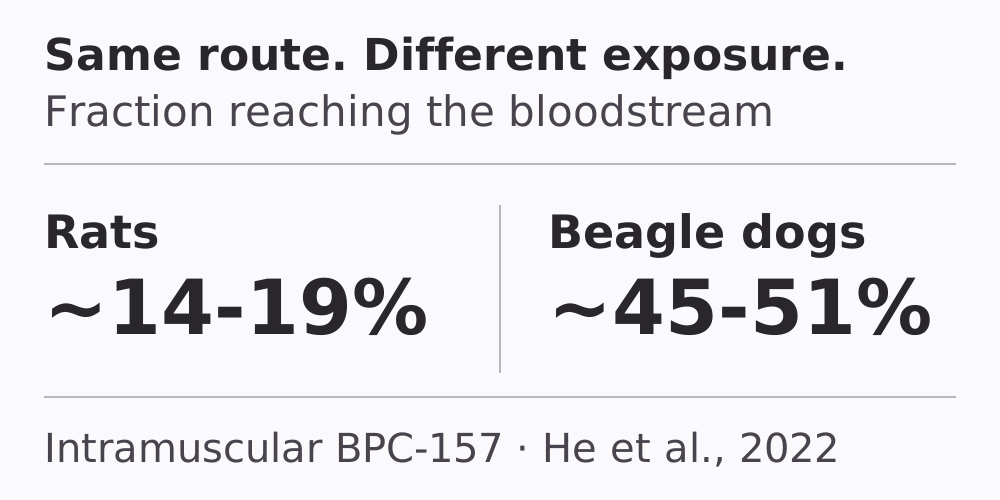
After intramuscular administration, bioavailability was ~14-19% in rats and ~45-51% in dogs. Bioavailability is the fraction reaching the bloodstream. The contrast below is why I distrust an animal dose quoted without its species and route.
A short-lived parent peptide could initiate downstream changes that last longer; that remains a mechanistic interpretation, with human onset and drug-test detection windows still unestablished. The dosage page puts the study amounts back in their experimental setting.